Dynamic LLM Routing for Scalable SaaS & Digital Transformation
Why One‑Size‑Fits‑All LLMs Don’t Scale
Large language models differ dramatically in latency, token cost, and specialized capabilities. Using a single, flagship model for every request may look simple, but at scale it inflates business process automation costs and hampers user experience. A more strategic approach selects the most suitable model for each query, aligning performance with budget and compliance requirements.
What Is LLM Routing?
LLM routing is a control‑plane pattern that evaluates each incoming request and forwards it to the optimal model backend. The router sits between your application layer and multiple LLM APIs, applying criteria such as task type, cost ceiling, user tier, and data sensitivity.
Request analysis: Detects complexity, domain, or compliance flags.
Request forwarding: Sends the query to the chosen model’s endpoint.
Fallback handling: Switches models when rate limits or failures occur.
Response aggregation: Merges or selects outputs from parallel model calls.
Logging & observability: Captures cost, latency, and model selection for continuous improvement.
Business Impact of Smart Routing
Frontier models like GPT‑4o can cost several times more per token than lighter alternatives (e.g., GPT‑4o mini, Mistral 7B). If 50 % of your traffic consists of simple summarizations or classifications, routing those to a cheaper model can save millions annually—turning a hidden expense into a clear line item.
Beyond cost, routing reduces latency for low‑complexity queries, delivering a faster experience that supports autonomous marketing campaigns. It also adds resilience: when a provider throttles or degrades, the router seamlessly fails over, keeping your SaaS product available.
Compliance‑driven organizations can route PII‑rich prompts to on‑premise or privately‑hosted LLMs, turning a technical optimization into a regulatory necessity.
Routing Strategies to Consider
Static (Rule‑Based) Routing
Define explicit rules—e.g., “code generation → specialized coding model, open‑ended Q&A → general‑purpose LLM.” This approach is fast, easy to debug, and ideal for predictable workloads. The main limitation is brittleness; as task distributions evolve, rules require manual updates.
Dynamic (Classifier‑Based) Routing
Deploy a lightweight classifier that scores query complexity at runtime. When the score exceeds a threshold, the request escalates to a high‑capability model; otherwise it stays with a cost‑effective alternative. This method captures the majority of real‑world queries without sacrificing quality and is a core component of many AI content automation pipelines.
Semantic Routing
Use embeddings to cluster queries by semantic domain and map each cluster to a domain‑optimized model. This is especially powerful for organizations that must separate sensitive data streams (e.g., health or finance) from public APIs, helping meet digital transformation compliance standards such as HIPAA or GLBA.
Cost‑Based & Failover Routing
Combine real‑time pricing data with user subscription tiers. Premium users receive high‑performance models, while free users get cost‑optimized responses. Simultaneously, monitor provider health and automatically reroute when a primary model becomes unavailable.
Cascading
Start with the cheapest model; if its output fails a quality check, cascade to a more capable model. Research shows cascading can achieve frontier‑model quality at a fraction of the cost, a compelling tactic for SaaS scalability.
Engineering Considerations
Classifier drift: Query patterns shift over time, so routing models need regular retraining and benchmark validation.
Multi‑provider credentials: Secure storage (e.g., a secrets manager) and a unified configuration layer simplify API‑key rotation and rate‑limit management.
Observability: Detailed logs that capture model choice, cost, and latency are essential for SEO optimization reporting and continuous improvement.
Pro tip: n8n’s execution history records every routing decision step‑by‑step, turning debugging from hours into minutes.
Getting Started Quickly with n8n
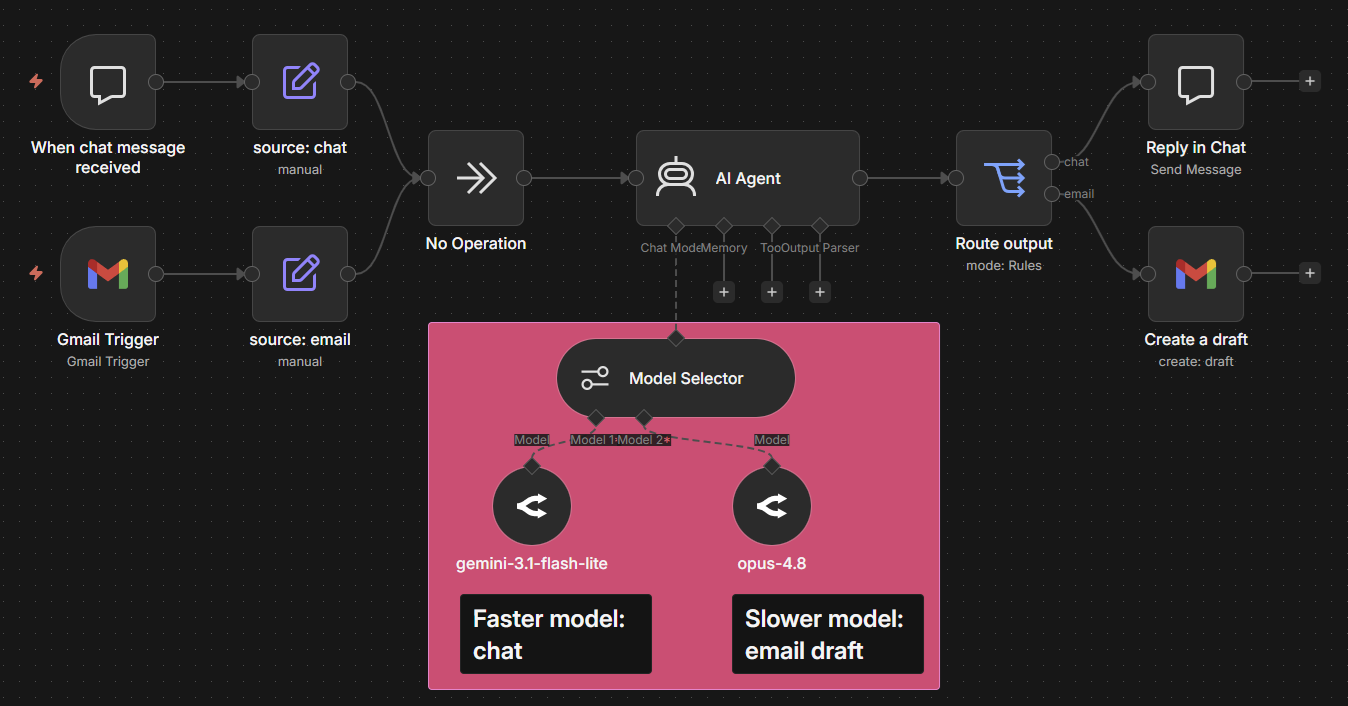
n8n provides a visual, version‑controlled workflow layer that lets you assemble a routing pipeline without custom code. The built‑in Model Selector node, together with native integrations for OpenAI, Anthropic, and other providers, lets you map request types to the appropriate LLM instantly.
When the routing classifier needs adjustment, you simply edit the workflow. When a new provider is added, you plug in a new node—no deployment cycle required.
The Model Selector node and AI Agent node enable flexible, low‑code routing for autonomous marketing workflows.
Explore the Dynamic AI Model Router workflow in the n8n gallery to see a ready‑to‑use example that handles cost‑based routing, failover, and cascading logic.
Conclusion
LLM routing is not a speculative trend; it is a practical response to real‑world cost, latency, and compliance challenges that emerge as AI adoption grows. By starting with a simple static rule set and evolving toward dynamic, semantic, or cascading strategies, you can future‑proof your business process automation stack while delivering fast, accurate results for your customers.